The short answer
Why advocate proactive point-of-use filtration in schools? Because lead can enter water through building plumbing, a test is a snapshot, and children use that water every day. Independently certified filtration at drinking and food-preparation outlets can add a practical layer of protection-when the exact system is selected for the relevant contaminants, installed correctly and maintained. It complements, not replaces, testing and remediation.
What Get the lead out New York found: lead in New York school water
Get the lead out New York: Why New York State’s efforts to get lead out of school drinking water are still inadequate, published in September 2026 by Tony Dutzik, David Masur and Blair Horner, examines school-reported lead testing data from the New York State Department of Health. Its central finding deserves the attention of every leader responsible for school drinking water. [1]
- 42%
- of schools in the analysis reported at least one outlet above 5 ppb.
- 12,452
- outlets tested above the state’s lead action level.
- 4,514
- public schools and BOCES locations supplied the analyzed data.
Specifically, 1,918 schools reported an exceedance among 221,078 outlets with reported test results. The authors downloaded the state datasets on July 13, 2026, using complete 2026-2028 results where available and otherwise using 2023-2025 results. These are reported testing findings, not a live inventory of outlets currently in use or proof that all affected schools remain unremediated. The authors also identify gaps and inconsistencies in the reporting system. [1]
Get the lead out New York also compared 525 schools that had reported results for the new testing cycle with their earlier results. Of those, 312 reported more outlets above 5 ppb. That subset is not a statewide prevalence estimate, but it reinforces a concern: an outlet described as remediated in an earlier cycle may still require attention later. [1]
Those numbers are not a reason to panic. They are a reason to plan differently.
Lead testing tells us what happened. Strategy determines what happens next.
Lead is not something a child can reliably see, taste or smell in a glass of water. Get the lead out New York describes lead as a neurotoxin and cites public-health guidance that there is no known safe level of lead exposure. A clear-looking glass is not a water-quality assessment. [1]
Lead release can vary with water chemistry, stagnation, use patterns and plumbing conditions. A sample provides valuable evidence under the conditions in which it was collected. It does not promise that the same outlet will produce the same result every day for the next three years. [1]
New York’s school lead action level is currently 5 micrograms per liter, equivalent to 5 parts per billion (ppb). State rules require a response when an outlet exceeds that level, including taking it out of use, providing an alternative water supply, remediation, retesting and required notifications. Schools should follow the full rules and their health department’s guidance. [2] [3]
Get the lead out New York recommends a different policy approach: lead-reducing filters at all drinking-water outlets and a tighter 1 ppb target. That is the authors’ recommendation-not New York’s current legal action level or a statewide filter mandate. Meeting a regulatory threshold and designing a proactive protection program are related, but they are not the same decision. [1]
We don’t have to choose between meeting today’s requirements and building a better plan for tomorrow.
Who needs this information-and why lead matters to them
This is not just a plumbing issue. It touches student health, daily operations, procurement, capital planning and community confidence.
- New York State Education Department, district superintendents, school boards and BOCES leaders: connect school water decisions with clear oversight, budgets and accountability. The state lead testing program is administered by the Department of Health; education leaders still have an important operational and planning role. [2]
- New York City Department of Education / NYC Public Schools: a consistent approach across buildings can help teams move beyond isolated fixes toward a documented program.
- Division of School Facilities (DSF): this is the verified name of NYC’s facilities division. Its building maintenance and repair responsibilities make installation access, plumbing compatibility, cartridge replacement and service records essential considerations. [4]
- New York City School Construction Authority (SCA): capital planning, new construction and major renovations offer opportunities to specify water protection before a building or project opens, rather than retrofit it later. [5]
- Facilities directors, purchasing teams and school business officials: compare the full cost of ownership, not just a filter’s purchase price. A system without a funded service plan is not a complete solution.
- PTAs, families, school nurses and community advocates: ask for understandable results, a clear outlet map and evidence that maintenance is actually happening-not simply reassurance.
These organizations are named because the subject is relevant to their responsibilities. No endorsement, affiliation or existing client relationship is implied. The same planning principles can support school districts and communities beyond New York, with local requirements reviewed separately.
Why lead protection belongs at the faucet and fountain
Point-of-use (POU) treatment places protection close to where someone drinks or where food and beverages are prepared. That matters because lead can enter water from plumbing and fixtures inside a building, after the water has left the utility’s system. Treating water only where it enters a building may not address lead introduced downstream. [1]
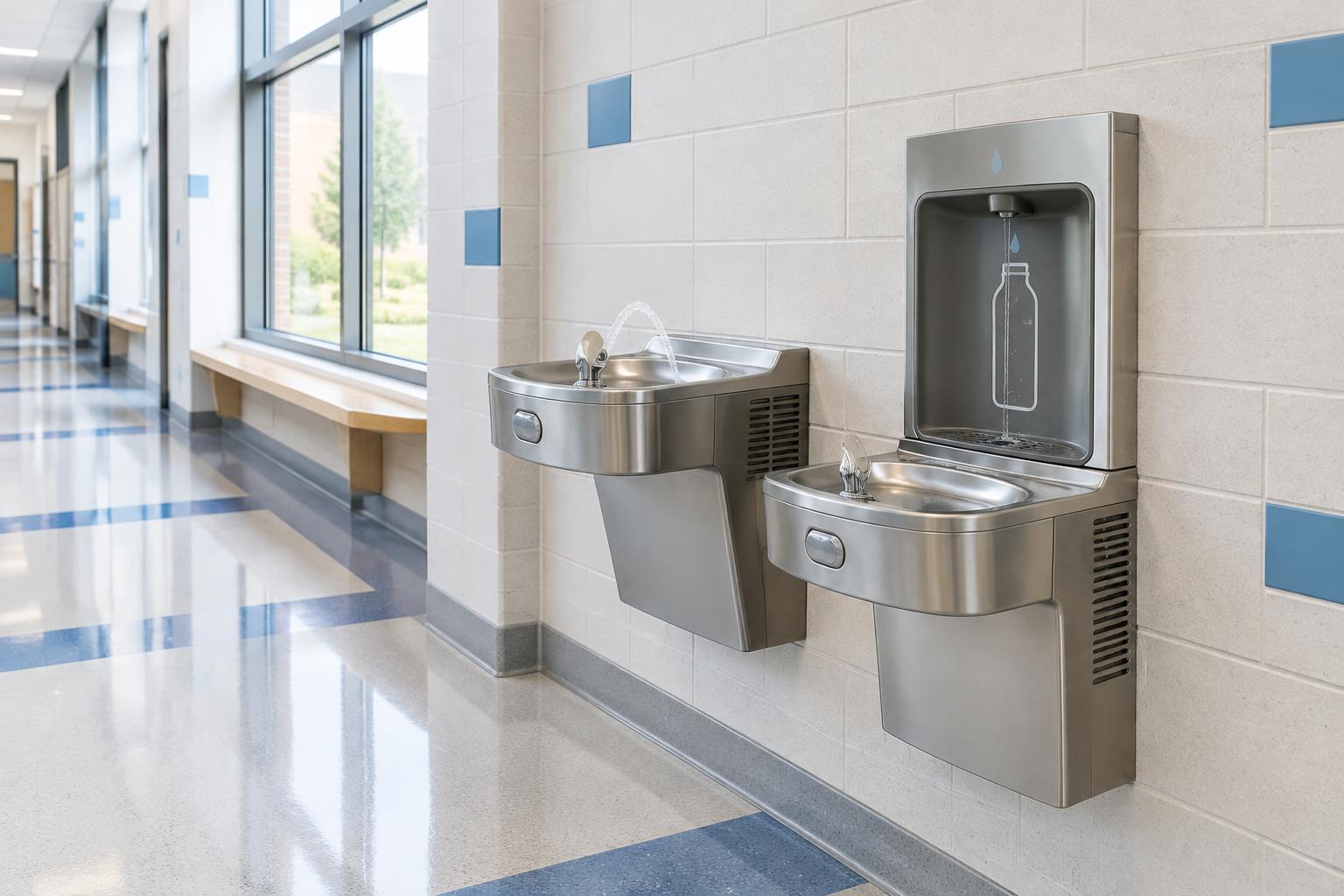
At H2OCleanse, we advocate a proactive strategy for every faucet, fountain and bottle-filling outlet used for drinking, cooking or beverage preparation. Not a random selection of the most visible fountains. Not just the outlet that failed last time. The aim is a consistent protective layer at the points where ingestion occurs.
That does not mean installing the same device on every sink. Restroom, custodial and other non-drinking outlets need clear use designations and a site-specific assessment. Fixture design, flow, accessibility, installation position and the potential for lead-containing components after the filter all matter.
Filtration is part of the plan-not permission to ignore deteriorating plumbing, skip required sampling or use water against a public-health advisory. A boil-water notice or suspected microbial contamination requires the response directed by the relevant authorities, even if a filter is present.
Lead is urgent. A scientifically grounded strategy looks beyond it.
Get the lead out New York is about lead. It does not establish that the schools studied also had PFAS, microplastics, bacteria, viruses or industrial solvents in their water. We should not use a lead finding to imply evidence of contaminants it did not measure.
Still, when a school is investing in a water protection program, it makes sense to ask a broader question: what other relevant, independently verified reduction claims can the selected technology provide?
Potential concerns include PFAS-often called “forever chemicals”-including PFOA and PFOS; microplastics; selected industrial solvents; and, where source conditions or an incident warrant it, bacteria and viruses. PFOA is a member of the PFAS family, not a separate contaminant category. The appropriate scope starts with source-water information, local context, testing where warranted and the exact product’s documented capabilities-not an assumption that every school has every risk.
“NSF certified” is the beginning of the question, not the end.
NSF explains that certification must be checked against the specific contaminant-reduction claims for the model and cartridge being purchased. A standard number alone does not tell you everything a system reduces. [6] [7]
- Lead: verify an explicit lead-reduction claim, such as certification under NSF/ANSI 53 or an applicable reverse-osmosis standard. EPA’s guide explains how to identify lead-certified filters and why particulate-reduction certification also matters. [8]
- PFAS, including PFOA and PFOS: verify which PFAS compounds or grouped claims are listed, and the tested performance conditions. “PFAS reduction” does not mean every member of the PFAS family is covered.
- Microplastics and emerging contaminants: look for the exact listed reduction claim and its test conditions. NSF/ANSI 401 addresses selected emerging contaminants; it is not a blanket promise about everything emerging. [7]
- Industrial solvents: match the specific chemical of concern to the product’s certified claims. A broad phrase such as “chemical removal” is not enough.
- Bacteria and viruses: do not assume a conventional lead filter is a microbiological purifier. Where this protection is needed, verify appropriate microbiological performance, such as claims evaluated under NSF P231 or P248, together with permitted use conditions.
No single certification guarantees protection against every present or future contaminant. Our goal is the strongest appropriate, verifiable protection for your setting, with useful breadth of coverage-not the longest list of marketing claims.
Make the lead-filtration budget go further by buying a strategy, not just equipment.
Schools have competing priorities. Asking a facilities team to spend more without giving them a defensible plan is not helpful. The better question is: what investment delivers relevant protection, reliable operation and a cost the district can sustain?
A budget-ready comparison should include equipment, installation, cartridge capacity and replacement frequency, labor, sampling, flow requirements, accessibility, downtime and the cost of alternative drinking water during disruptions. A lower upfront price can become a higher recurring expense. A more capable system can also be unnecessary if its additional claims are irrelevant to the site.
When suitable certified technologies address several identified concerns in one planned installation, they may reduce duplicated purchasing and fragmented service. That is a potential planning benefit, not a guaranteed saving or a promise of universal protection. We should quantify it against the district’s actual outlets, use and maintenance resources.
There is an environmental planning opportunity too: dependable refill access may help a school reduce reliance on disposable bottles. Whether that benefit is realized depends on the program’s use, maintenance and procurement choices. Water strategy should support community health, environmental sustainability and infrastructure resilience together.
A practical school lead plan: assess, specify, sustain, communicate.
- Map the actual exposure points. Inventory fountains, bottle fillers, classroom drinking taps, kitchens and food-preparation outlets. Record how each is used, its test history and its current status.
- Review the evidence and obligations. Gather existing lead results, source-water reports, remediation records and applicable rules. Identify any additional testing justified by the site-not an indiscriminate testing shopping list.
- Set a defensible specification. Document the required contaminant claims, flow, capacity, fixture compatibility, accessibility and installation requirements. Verify the exact model and replacement cartridge in the certifier’s current listing.
- Build a phased, funded implementation. Prioritize identified exposure and operational needs while keeping the whole drinking-outlet inventory in view. Meet required remediation obligations immediately; a phased plan must not delay a required response.
- Assign ownership before installation. Name the team responsible for replacements, service records, verification and exceptions. Fund recurring work and define what happens when an outlet is unavailable.
- Communicate what is known-and what is not. Give parents, staff, boards and key decision makers plain-language results, actions, limitations and progress updates. Trust is earned through a visible process, not a one-time announcement.
The payoff is not a slogan that every drop is perfect. It is a better-protected drinking-water program, a clearer use of limited resources and decisions your team can explain with confidence.
Questions school leaders ask about lead
Are filters required at every New York school faucet?
Get the lead out New York recommends filters at drinking and food-preparation outlets. That recommendation is not a current statewide mandate. New York requires lead testing and a response to results above its 5 ppb action level. Verify current rules and local guidance before making a compliance decision. [2] [3]
Does a result below 5 ppb mean there is no lead?
No. An outlet can contain detectable lead below the action level. “Below the action level” describes a regulatory result, not an absence of lead or a guarantee about later samples. Get the lead out New York distinguishes the current threshold from its recommended 1 ppb target. [1]
Can one filter reduce lead, PFAS, microplastics, bacteria and viruses?
Some technologies offer multiple verified reduction capabilities. Coverage depends on the exact system, cartridge, certification claims and operating conditions. Do not infer microbial protection or all-PFAS coverage from lead certification, and do not assume every NSF-certified product has the same claims. [6]
Can filtration replace school lead testing?
No. A proactive filtration program complements required testing, remediation, maintenance and notifications. Keep the school’s compliance process intact and follow applicable sampling instructions. [2]
How can a district make a limited budget work harder?
Start with the outlet inventory and actual risks, then compare lifetime costs and relevant certified performance. A coherent district plan can identify where broader coverage is valuable, where it is unnecessary and how recurring service will be funded. Savings need to be calculated, not assumed.
From concern to a clear plan
Your next step does not have to be another isolated fix.
Bring your school’s water results, outlet questions or budget constraints. We can work with school districts and communities wherever they are to define an evidence-led strategy, evaluate scientifically verified technologies and put maintenance and communication into the same plan.
Protect community health. Make your budget go further. Build confidence through evidence.
Book a school water consultationExplore our consulting framework · See our technology and communication approach
Sources & the original report
Original analysis by Heather A. Kollar for H2OCleanse. Factual references checked October 15, 2026. Report findings are attributed to their authors; H2OCleanse’s broader filtration recommendations are separate editorial analysis. H2OCleanse consults on and distributes certified water technologies and may have a commercial interest in technology recommendations. This article is not legal advice or a substitute for public-health instructions.
- Get the lead out New York: Why New York State’s efforts to get lead out of school drinking water are still inadequateNYPIRG, Environment America Research & Policy Center and Frontier Group, September 2026. Executive summary pp. 4-6; testing and recurrence pp. 9-17; recommendations pp. 18-19; methodology pp. 25-26. Page references use the report’s printed page numbers.
- Lead Testing in School Drinking WaterNew York State Department of Health. Current school testing program and 5 ppb action level.
- 10 NYCRR §67-4.4: ResponseNew York State Department of Health. Required response, alternative water, retesting and notifications after an exceedance.
- Facilities - Division of School FacilitiesNYC Public Schools. Official division name and building maintenance responsibilities.
- School Construction Authority - agency responsibilitiesCity of New York, Preliminary Mayor’s Management Report 2026. Capital planning, design, construction and major renovations.
- Contaminant Reduction Claims GuideNSF. Verify contaminant-specific reduction claims rather than relying on a standard number alone.
- NSF/ANSI 42, 53 and 401 filtration standardsNSF. Different standards serve different purposes; certification is not blanket coverage.
- How to Identify Filters Certified to Reduce LeadU.S. Environmental Protection Agency, June 2024. Lead-reduction certification and particulate-reduction guidance.
Get the lead out New York is linked on its publisher’s website, unchanged. Its stated license is Creative Commons Attribution-NonCommercial-NoDerivatives 3.0; the report is not republished here. This article is an original discussion, not a reproduction or an endorsement by its publishers.